
Thalia: reliable RFID identification
for nestable reusable containers

- Customers
- Case studies
- Thalia RFID container case study
Executive summary

Thalia needed reusable containers that could support automated logistics and save space on return journeys. Georg Utz GmbH and an identification specialist developed a solution combining nestable containers with permanently integrated barcode and RFID labels. The project addressed a specific technical challenge: reliably identifying large groups of containers when their labels sit close together.
The client
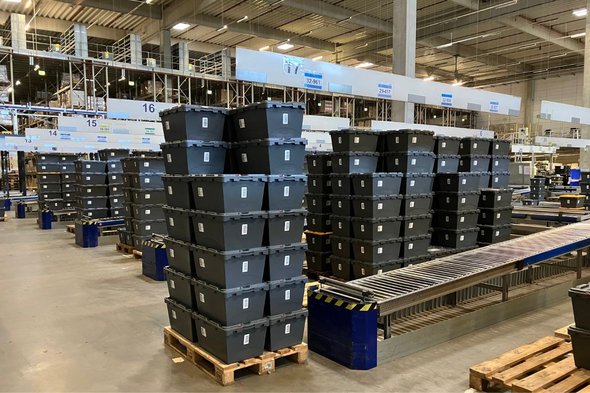
Thalia is a bookseller serving customers through retail stores and e-commerce in the German-speaking market. Its omnichannel hub in Marl combines store supply and online order fulfillment. The hub’s AutoStore system uses 530 robots and has 280,000 container storage locations, illustrating the scale of its automated operations. The container project focused on reusable containers for supplying Thalia’s retail store network.
The challenge
A major logistics challenge was handling consumer orders and store replenishment within one operation. The two sales channels had to be served in parallel, combining individual online orders with deliveries to stores. Within this wider operation, the store supply process required reliable goods protection and clear visibility of container movements. Unique container identification was a key requirement for recording, tracking and managing those movements within automated logistics and sorting processes.
The containers were designed to nest when empty, reducing the space needed for return transport. Nesting, however, brings RFID labels into close proximity. Adjacent antennas can interfere with one another, while radio signals can be weakened or shielded. This made label design and positioning particularly important.
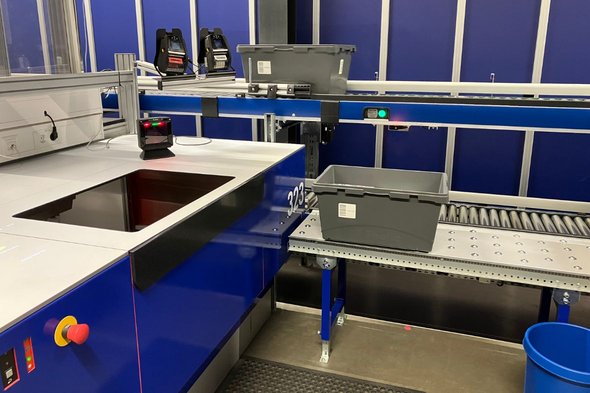
The scale of data capture added another requirement: the system needed to read up to 120 containers in a single reading cycle. Thalia also aimed to reduce manual data capture and potential sources of error.
Copyright: paulpabst/Thalia 2025
The solution
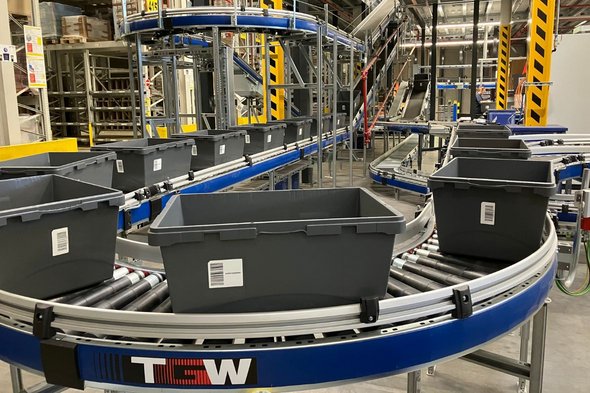
Georg Utz GmbH used reusable containers equipped with RFID in-mold labels from the identification specialist. The labels were permanently integrated into the container during injection molding, combining the container and its identification in a single physical solution.
The label development was tailored to the application. It focused on antenna design for minimal spacing, a defined label position within the injection mold, and reliable readability when containers were stacked.
Each container carried four labels:
- Two in-mold labels featuring a Code 128 barcode.
- Two RFID in-mold labels, each also featuring a Code 128 barcode.
This arrangement supported both barcode scanning and RFID identification across different process steps. RFID provided bulk data capture, while the barcodes retained an alternative identification method.
Permanent integration also gave the labels mechanical durability and resistance to wear, supporting identification through repeated container use.
The identification system had to work on Georg Utz GmbH’s production equipment as well as in Thalia’s logistics processes. The identification specialist supplied the four-label sets in four separate stacks. These stacks had to remain synchronized so that each container received the correct numbering sequence and retained its unique identity.
The project involved development, production and delivery under a demanding timeline. Extensive testing and the targeted combination of RFID and in-mold technology addressed the project-specific requirements. The completed solution was integrated into existing processes.
Key features of the solution
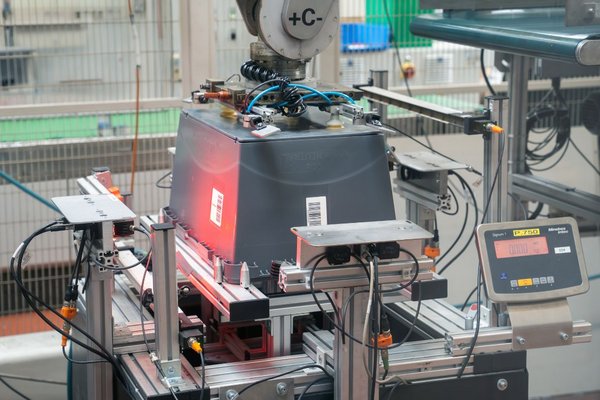
- Nestable design: Empty containers nest to save space during return transport.
- Integrated identification: Barcode and RFID labels are permanently incorporated during injection molding.
- Application-specific RFID design: Antenna design and label positioning address the close spacing between nested containers.
- Flexible data capture: Four labels per container support both barcode scanning and bulk RFID reading.
The result
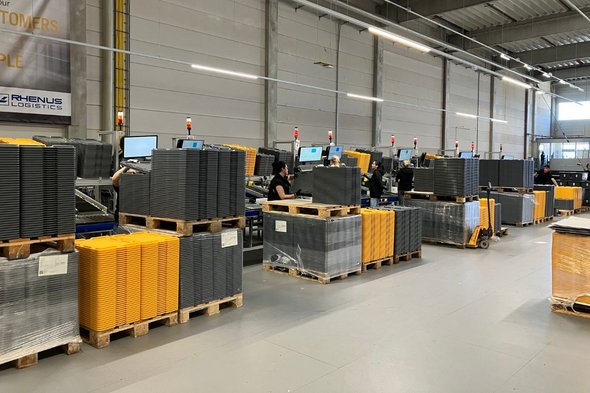
The project enabled more transparent tracking of container movements and faster data capture. Bulk RFID reading reduced the need for manual scanning and potential sources of error, while the nestable design supported space-saving return logistics.
Thalia’s omnichannel hub in Marl can deliver 600,000 books per day to consumers and stores. Handling online orders and store replenishment together at this scale was a major logistics challenge.
Conclusion
These outcomes came from aligning the physical container with the identification technology and the way containers were handled. Container geometry, antenna design, label positioning and production synchronization all contributed to the solution.
The Thalia project shows how reusable containers and integrated identification can be adapted together for automated retail logistics, including applications where nesting creates demanding RFID reading conditions.

Ready to discuss your requirements?
Need reusable containers suited to your logistics processes and return flows? Discuss your packaging and identification requirements with Utz Group.
Request consultationAutomotive and manufacturing case studies

Optimized logistics at MAN
MAN enhanced warehouse efficiency with Magazino's SOTO robots. Explore their logistics automation success and learn how robotics can optimize your operations.
Read case study
Optimizing material flow at Handtmann
By integrating 30,000 Utz EUROTEC containers into a new automated Dematic Multishuttle system, the company significantly accelerated its internal material flow.
Read case study
Lithium-ion battery packaging
Discover how Utz developed an innovative packaging solution for lithium-ion batteries, enhancing safety, handling, and transportation for a leading electromobility manufacturer.
Read case study
Production optimization for vinyl records
Utz Group designed and produced 45,000 custom vinyl record containers for GZ Media, Europe’s largest vinyl record manufacturer.
Read case study
SICK optimizes production logistics with Utz
How Utz and KNAPP helped SICK streamline manufacturing operations with durable, automation-ready EUROTEC bins over a 20-year partnership.
Read case study
Plastic pallets for battery cells
PowerCo needed a pallet solution for battery cell production that could operate in clean and dry rooms while remaining compatible with the established VW pallet standard.
Read case study