
How standardized trays
make product variety easier to automate

How standardized trays make product variety easier to automate
Automated warehouses perform most consistently when every load presents the same predictable interface. In practice, however, manufacturers and distributors handle cartons, bags, wrapped products and individual items in many different dimensions, weights, and shapes.
A conveyor may need to transport a small lightweight package immediately after a large carton. Some products have unstable bases. Others can rotate, tip, deform, or become caught during transfer. Cardboard packaging can vary enough to complicate conveying, accumulation and automated storage.
Standardized plastic trays provide a practical way to manage this variability. Rather than designing the automation around every product and package format, the warehouse can be designed around the tray.
The products remain different. The interface with the automation stays consistent.

The system handles the tray, not every individual package
When goods travel directly on conveyors, their packaging becomes part of the material-handling system. Its dimensions, surface, rigidity, and stability can influence how the product moves through curves, transfers, and accumulation zones.
The greater the product variety, the more operating conditions the system must accommodate. Conveyor gaps may need to allow for the largest package. Sensors must reliably detect very different shapes. Start-and-stop movements must account for products that could slide, rotate, or tip.
Placing these products on trays creates a standardized footprint beneath them. The conveyor, shuttle, or automated storage and retrieval system interacts with a consistent load carrier instead of repeatedly adapting to different packaging formats. This can enable tighter conveyor gaps, more predictable accumulation, and more consistent transfer behavior.
Utz develops custom plastic trays for transport, storage, and automation applications. Depending on the project, trays can be designed around conveyor systems, shuttle equipment, robotic handling, lifting devices, and camera-based processes.

Standardization can simplify warehouse engineering
A standardized tray gives system designers a defined set of dimensions and handling characteristics.
Instead of engineering each transport section around a broad range of cartons and products, designers can focus on one repeatable interface. This can make it easier to configure:
- conveyor curves and transfer points
- accumulation zones
- sensor and camera positions
- start-and-stop windows
- shuttle and storage interfaces
- lifting and product removal processes
The objective is not simply to place another item underneath the product. It is to reduce the number of variables the automation must manage.
This consistency can also support commissioning and optimization. When every load carrier behaves in a similar way, irregular movement is easier to identify, and system parameters can be adjusted around a stable baseline.
Bring more product formats into automated workflows
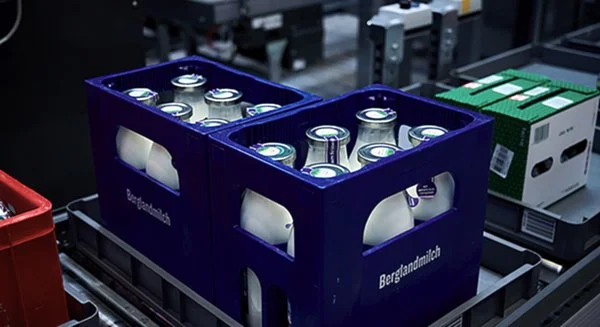
Without trays, some products may require manual handling or separate conveyor processes. Small items can be difficult to transport on roller conveyors. Bags and stretch-wrapped packs may catch or deform. Bottles, liquids and products with uneven bases may become unstable at higher conveying speeds.
A tray shifts the handling requirement from the product to the load carrier. This can allow a wider range of goods to travel through the same automated system, reducing the need for product-specific exceptions. Grocery distribution is one example, but the same principle can support manufacturers and distributors working with industrial components, consumer goods, electronics, cosmetics, pharmaceuticals, fashion products, mail or other varied assortments.
Expanding automation coverage may also reduce manual interventions. Employees can concentrate on value-adding picking, replenishment and quality tasks instead of repeatedly moving products between automated and manual routes.

Protect cartons as they move through automation
Cardboard packaging is often suitable for shipping, branding or order preparation, but it is not always designed to function as a precision conveyor interface.
Cartons may differ in size, strength, and base condition. Repeated contact with conveyors, shuttle equipment and transfer points can cause abrasion, deformation or damage—particularly when cartons are heavy, unstable or used for multiple handling cycles.
A plastic tray allows the carton to remain in the product container while the tray becomes the conveyance medium. The carton is placed on a stable base designed to interact with the automated equipment.
This approach can:
- stabilize cartons of different dimensions
- reduce direct contact between cardboard and conveyor components
- support smoother movement through transfers and curves
- help protect carton bases and edges
- provide a consistent surface for storage and retrieval equipment
Utz trays can incorporate reinforced bases, edge reinforcements, lifting openings, surface textures, or movable inner plates depending on the handling process. Utz also offers trays specifically designed to guide and secure cardboard boxes through automated systems.
Use automated storage positions more flexibly
Tray-based storage can also change how an automated storage and retrieval system uses its available locations.
Depending on the dimensions and system configuration, several cartons or product units may be placed on one tray and stored within a single location. The system can retrieve the tray, allow the required quantity to be picked, and return the remaining stock to storage.
This can support:
- better use of the available storage space
- flexible single-unit or multiple-unit picking;
- fewer partially used storage locations;
- improved access to remaining inventory;
- more effective use of automated storage assets.
The exact improvement depends on product dimensions, tray layout, storage geometry, and picking strategy. However, the principle is straightforward: the relationship between a storage position and an individual carton no longer must be one-to-one.
Product protection and process performance are connected
Product damage is not only a packaging issue. In an automated warehouse, it can create wider operational consequences.
A damaged carton may stop at a transfer point, generate an unreadable label, obstruct another product, or require manual removal. Liquids and fragile goods can create even greater disruption when damaged.
By providing a stable interface, trays help separate the product’s packaging characteristics from the mechanical demands of the automation. This can support both product protection and more predictable material flow.
The tray design must still be matched to the application.
Important considerations include:
- load dimensions and weight
- center of gravity and stability
- conveyor and shuttle geometry
- required base stiffness
- friction and surface characteristics
- product loading and removal
- stacking and empty-tray handling
- cleaning requirements
- identification and tracking
Utz can manufacture trays using injection molding, thermoforming, or a combination of an injection-molded base and thermoformed interior. The suitable approach depends on factors such as production volume, geometry, precision, material, and structural requirements.

Empty trays must also be part of the system design
A successful tray concept should consider what happens when trays are not carrying products.
Empty trays can be collected, stacked, and stored efficiently until they are needed again. This reduces the space required for empty load carriers and makes it possible to maintain a reserve of trays outside the active material flow.
That reserve can be useful during temporary peaks in demand. Additional trays can be reintroduced into the system when throughput increases, helping the operation respond to changing volumes without keeping every tray in circulation at all times.
For this reason, empty-tray handling, stacking, and storage should be considered as part of the overall automation concept from the beginning.
Trays supporting automated fashion logistics at PUMA

PUMA’s European distribution center demonstrates how trays can support automation beyond grocery logistics.
TGW developed the automated intralogistics system, while Utz supplied 550,000 plastic trays. Cardboard boxes are transported on the trays through the automated system, providing a consistent interface for storage and material flow.
The trays were designed to integrate with TGW’s shuttles and conveyor network. Their defined dimensions and adapted base geometry support reliable automated handling, while the cartons placed on them can retain their different formats.
Standardizing different carton sizes for Dior

Parfums Christian Dior faced a similar requirement in a different product environment: its automated logistics operation had to handle both full cartons for retail distribution and individual item flows for e-commerce.
KNAPP provided the robotics and software, while Utz supplied 36,600 custom trays for the automated shuttle system. Different carton sizes are placed on standardized trays, allowing the system to store and transport them with a uniform handling interface.
The tray design also supports double-deep storage within the shuttle system and goods-to-person workflows in which robots deliver trays to picking workstations.
Standardized trays for a diverse product range at SPAR

SPAR’s distribution center in Ebergassing shows how standardized trays can support automation when a wide variety of products needs to move through the same logistics system.
Their standardized dimensions provide a consistent interface for the automated storage and retrieval system, while helping keep goods stable during handling. The trays can also be stacked efficiently when empty, supporting space-saving storage and reuse.
See how Utz trays support automated store deliveries at SPAR
One stable interface for a varied product range
Manufacturers and distributors do not need every product to look the same before they can automate its movement.
They need the automation to see a consistent interface.
A well-designed tray can provide that interface while supporting product protection, storage utilization and a broader automated assortment. It can carry a small packaged component, an unstable product, a bottle, a flexible pack or a cardboard carton without requiring the entire conveyor and storage system to accommodate each format independently.
Standardization at the load-carrier level can therefore become a foundation for:
- simpler system design;
- more predictable material flow;
- broader automation coverage;
- reduced handling exceptions;
- better product and carton protection;
- flexible storage and picking;
- more effective use of automated warehouse capacity.
The appropriate tray design depends on the products, automation equipment, and operating process. Utz works with customers and system partners to develop reusable trays around these specific requirements.


